
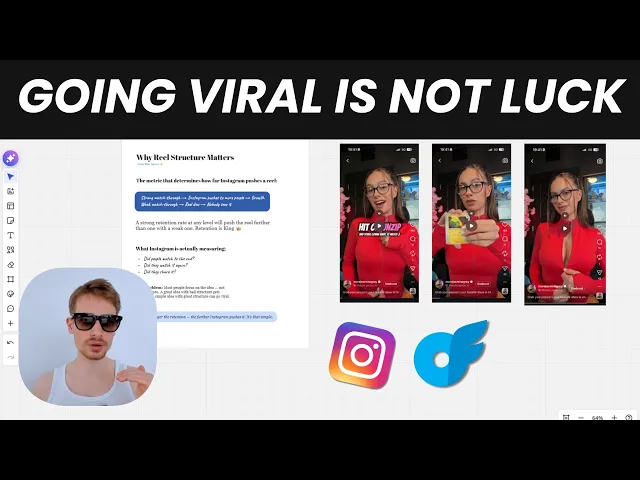
How to Make Viral Reels for OnlyFans
The three-part structure behind reels that actually convert to OnlyFans subscribers — hook, middle, payoff — with two real examples and the checklist to run before you post.
Before I managed OnlyFans accounts, I was growing hot girl pages on Instagram. One thing kept showing up: how attractive the girl was, or how good the idea sounded, almost never decided whether a reel went viral. The reels that worked all shared the same structure. The ones that flopped were almost always missing one piece of it.
That applies to OnlyFans accounts on Instagram exactly as much as anywhere else.
Why reel structure matters
The metric that decides how far Instagram pushes a reel is retention. Strong watch-through, Instagram pushes it to more people — growth. Weak watch-through, the reel dies and nobody sees it. A strong retention rate at any production level beats a weak one at a high production level. Retention is king.
What Instagram is actually measuring: did people watch to the end, did they watch it again, did they share it. Most people obsess over the idea and ignore the structure. A great idea with bad structure gets ignored. A simple idea with great structure can go viral.
The three-part structure
Every reel that converts follows the same shape:
Hook (first 1–2 seconds) — the only job is to stop the scroll.
Middle (the build) — keep them watching.
Payoff (the reward) — give them a reason to follow, and to watch to the end.
Most reels fail in the middle. The hook works, but nothing pulls the viewer to the end. Skip the hook and nobody watches past the first second. Skip the middle and people drop off early. Skip the payoff and nobody follows, shares, or replays — and replays are what tell Instagram to push it further.
Two examples worth studying. One creator opens Pokémon card packs on camera and plays a simple game: if she hits a rare card, she does something for it, if she doesn't, she doesn't. The viewer watches the whole thing just to find out which way it goes. Another does a "high or low" bikini format — she states the premise, pulls it high, then pulls it low, and the guy watches through to compare both. Neither is complicated. Both are built entirely around making someone watch to the end to resolve a question the hook planted.
The hook (1–2 seconds)
One job: make scrolling past feel like a mistake.
What works: start mid-action, something already happening. A visual surprise. An open loop that creates a question in the viewer's mind immediately. A pattern interrupt — something that breaks what they expected to see.
What kills it: a slow start, a black screen or fade-in, opening on a logo or text, or looking at the phone to set up the shot. Every one of those is unnecessary seconds shaved off what could've been the hook.
The 6-second rule: if you haven't given someone a reason to keep watching by second three, you've lost them. Most short reels only get one or two seconds of patience before the thumb moves.
The middle
Its job is to make leaving feel worse than staying.
What works: tease the payoff without giving it away. Escalate gradually — each second slightly more interesting than the last. Add a twist or a reveal. Let personality carry it; if she's genuinely entertaining, people stay for her.
What kills it: the energy dropping right after the hook. Same shot, same energy, the whole way through. Running too long — for a short reel the middle should be 3 to 5 seconds, not more. Giving the payoff too early, which leaves nothing to watch for.
The retention test: if you can delete the middle and the reel still makes sense, the middle isn't doing its job.
The payoff
It has two jobs: reward the viewer for watching to the end, and give them a reason to follow, share, or watch it again.
What works: delivering on exactly what the hook promised. Being surprising enough that people want to share it. Leaving them wanting more instead of showing everything. Making them feel something — humor, surprise, attraction, connection, anything.
What kills it: underwhelming — the buildup promised more than the ending delivered, so nobody replays. An abrupt ending with no clear conclusion. Or a payoff that's just more of the same, with no escalation.
The reaction test: did the viewer feel something strong enough to actually do something — save it, rewatch it, comment, follow? Saves and shares are one of the strongest signals Instagram reads.
Putting it together
The full structure, in practice: hook — something happening immediately, no slow start. Middle — escalate, don't plateau, tease the payoff. Payoff — deliver on the promise, leave them wanting more.
Before you post a reel, run it through four questions:
Does the first frame make you want to keep watching?
Is there something pulling you toward the end?
Does the ending deliver on what the hook promised?
Is the total length as short as it can be while still working?
That's the whole mechanism. It doesn't require a bigger budget or a better camera — it requires every reel to actually have all three parts.
If you're posting reels every day and the views aren't turning into subscribers, structure is usually the first place to look before the idea itself. If you want that run for you — apply here.
More posts
The Ultimate Guide to OnlyFans Promotion and Marketing
A complete walkthrough of OnlyFans promotion — profile, social media, hashtags, teasers, exclusive content, and the analytics that tell you what is actually working.

7 Best Starter Tips to Earn More on OnlyFans
Seven starter tips for earning more on OnlyFans — quality content, knowing your audience, social media, exclusivity, pricing and staying consistent.
